Description
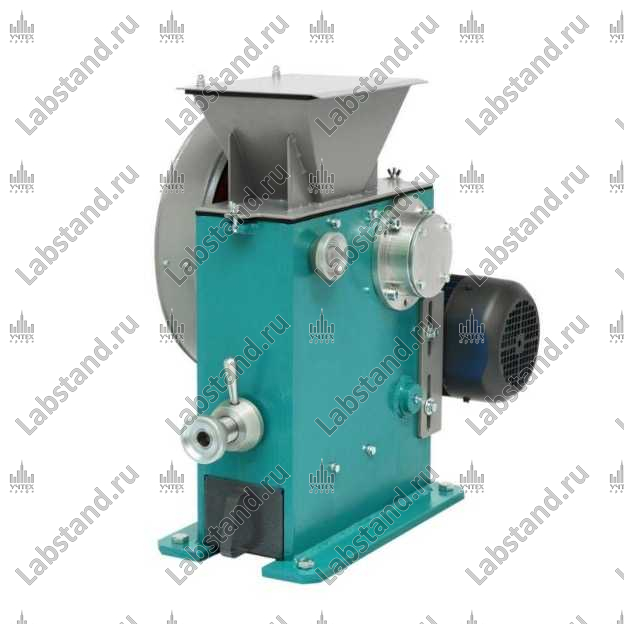
The laboratory jaw crusher is designed for crushing ores, minerals, slags and other materials of varying strength. A jaw crusher with a complex swing of the jaw, the destruction of the material in which occurs due to compression and shear deformations. The size of the crushed material is determined by the gap between the jaws in the lower part (discharge slot) and the physical properties of the material. The crusher includes: a loading hopper, a housing, a base and a connecting rod mounted in it, a receiving container and an electric motor. There are two cheeks inside the body: a fixed one, fixed to the base, and a movable one, on the connecting rod. The base is suspended on an axis, and its position in the lower part is determined by an adjusting device. The screw of the adjusting device rests against the base through a stop with a shear pin, which protects the crusher from breakage when it gets into contact with an uncrushable body. Torque from the electric motor is transmitted through a belt drive to an eccentric shaft on which a connecting rod with a movable cheek is mounted. The material is fed into the loading hopper, from where it enters the working space between the cheeks. The upper surface of the cheeks is ribbed, which allows increasing the specific pressure on the particles of crushed material in the pre-crushing zone. The lower smooth surfaces of the cheeks form a parallel zone — the regrinding zone, in which the product of the required size is obtained. When the eccentric shaft rotates, the movable jaw moves relative to the stationary one, ensuring crushing and unloading of the material — when the jaws come together, the material is crushed, when the movable jaw moves away, it moves in the crusher and is unloaded. The crushed product is collected in an external container located under the unloading zone.
Specifications:
Average particle size of the crushed product with a minimum gap between the cheeks, no more than, mm 1.0
Particle size of the crushed product with a minimum gap between the cheeks, no more than, mm 2.0
Size of source material, mm, no more than 50
Particle size of the crushed product with a minimum gap between the jaws, less than, mm 2.0
Size of source material, mm, no more than 50
Dimensions of the loading window of the hopper, not less, mm 160×250
The size of the loading window of the crushing zone, not less, mm 60×100
Range of adjustment of the gap between the cheeks, mm, no narrower than From 2 to 15
Supply voltage, frequency 50 Hz, V 380
Electric motor power, not less, kW 1.1
Total volume of the crusher receiving tank, not less, l 1.4
Total volume of the support pedestal capacity, not less, dm3 6.5
Overall dimensions, mm (Length x Width x Height), not less than 640x340x600
Weight on the support stand and with the control panel, no more, kg 165
Jaw material — cast iron/ steel/ tungsten carbide, grade ChH16M2/ 110G13L/ WC
Jaw hardness — cast iron/ steel/ tungsten carbide, not less than 52/ 31 HRC/ 1180HV