Description
In a vibrating abrader, grinding occurs due to abrasion — simultaneous compression and shear deformation. The size of the crushed material depends on the operating time of the grinder and the physical properties of the material.
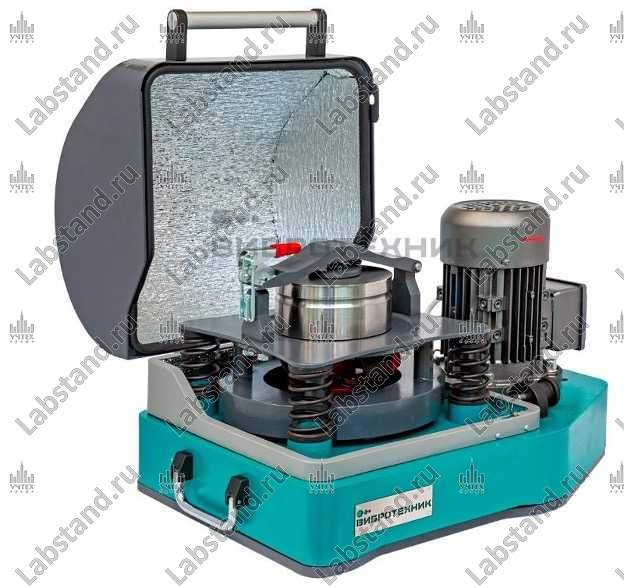
A platform with a quick-clamping device and six assembled bowls (consisting of a lid, four balls and the bowl itself) is mounted on the plate through springs. Rotation from the electric motor is transmitted through a belt drive to the drive shaft, which is mounted on a plate in a bearing unit. From it, the torque is transmitted through an elastic leaf coupling to the unbalance mounted on the platform axis.
The cover mounted on the plate is designed to provide sound insulation and limit access to the vibrating parts of the abrasive.
Principle of operation. The vibrating abrader platform (together with the bowls attached to it) performs circular vibrations in the horizontal plane. In this case, the balls make multidirectional movements inside the bowl. The material wears away between the walls of the bowl and the balls.
Specifications:
Parameter Meaning
Average particle size of abrasion product, no more than, µm 30
Minimum particle size of abrasion product, no more than 50 microns
Size of source material, mm, no more than 2
Loading volume of one bowl, not less, cm3 2
Abrasion time, no more, min 30
Hardness of the source material, no more than 8 according to Mohs
Number of bowls, no less, pcs. 6
Supply voltage, frequency 50 Hz, V 380
Electric motor power, not less, kW 0.37
Platform oscillation frequency, no less, number/min. 1500
Platform vibration amplitude, not less than, mm 3.5
Overall dimensions, mm (Length x Width x Height), not less than 509x395x310
Weight with Control Panel, no more, kg 59
Set material — tool steel / zirconium dioxide / tungsten carbide, grades KhVG or 9ХС / ZrO2 / WC
Hardness of sets (bowl, lid, roller) — tool steel / zirconium dioxide / tungsten carbide, grade 62 HRC / 1200HV / 1180 HV