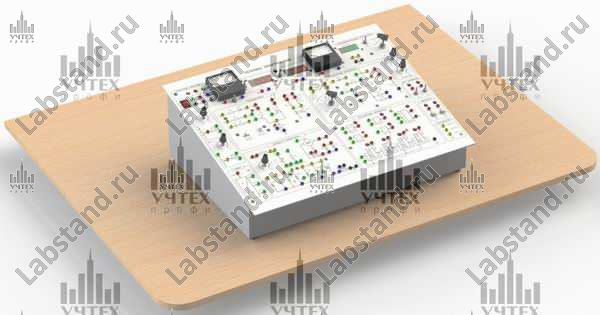
Description
Overall dimensions of the laboratory unit no more than (LxWxH) 650x350x440 mm
Study of the following types of coding and modulation of radio signals:
• Binary coding: BVN0 (NRZ), BVN1 (NRZI), Manchester, differential Manchester.
• Trinary coding: VN (RZ), AMI, HDB3, MLT-3, 4B/3T
• Tetra coding: 2B1Q
• Coding using substitution codes. 4B/5B
• Amplitude modulation
• Frequency modulation
• Phase modulation
• Quadrature modulation, QAM16
Study of the influence of interference on various types of coding/modulation, study of transmission speed on noise immunity
Specifications:
• Stand version – tabletop
• Stand power consumption no more than 50 W
Technical capabilities:
1. Select the encoding/manipulation and decoding/demodulation method using the buttons on the front panel.
2. Entering a number to encode from the keyboard
3. Random number generation (for manual decoding from an oscillogram).
4. Start transmit/receive in a loop.
5. Adding noise to the communication line with the ability to change the level.
6. Continuous measurement of signal strength or interference at the output of a communication line in relative units.
7. Indication of the current encoding/decoding methods, transmitted and received numbers, the current state of the transmitting/receiving unit, the number of bits transmitted/received with error or the signal strength at the input of the receiving unit.
8. The presence of sockets for connecting an oscilloscope to monitor the signal and noise at the input and output of the communication line.
Stand composition:
1. Laboratory installation.
2. Set of cables for connecting an oscilloscope
3. Stand operation manual
4. Recommendations for conducting laboratory work.
*Additionally, an Oscilloscope can be supplied to work with the stand.