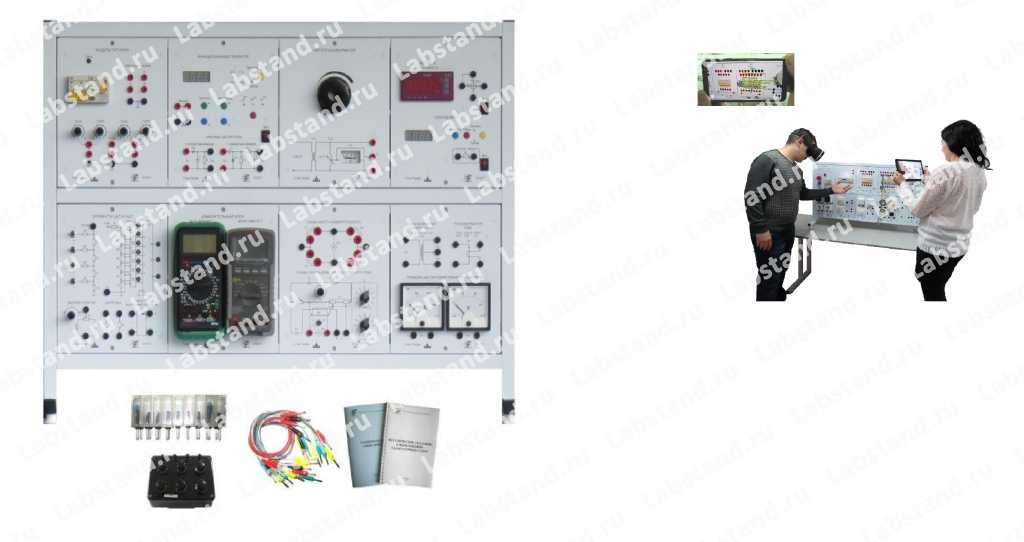
Description
Compound:
Modules:
o Power module (computer version)
o Function generator. Peak detectors
o Autotransformer
o Measuring unit
o Wattmeter. Stopwatch
o Current and voltage transformer.
Electromechanical measuring instruments
o Diagram of the measuring bridge. DC potentiometer circuit
o DAC and ADC elements
Set of minimodules
Resistance Shop
Frame 2×4
Set of connecting conductors and cables
Guidelines
Technical description
USB Oscilloscope Software on Flash Drive
Visual instructions «EIOM-AR» with elements
augmented reality technologies on a Flash drive
Video course with elements of augmented reality technology on a Flash drive
USB Oscilloscope Software (PC Version)
Technical characteristics of the kit
Power supply voltage, V 220
Supply voltage frequency, Hz 50
Power consumption, W no more than 100
Operating temperature range, ˚С +10…+35
Humidity, % up to 80
Overall dimensions 870x265x680 mm (LxWxH); weight no more than 30 kg.
List of laboratory works and experiments
1. Types and methods of measurements, measurement errors, accuracy classes of measuring instruments.
2. Direct measurements of voltage and current, electrical resistance and frequency of alternating current with digital multimeters. Determination of relative and reduced measurement error.
Topic 1. Measurements in DC circuits.
3. Study of electromechanical measuring instruments. Direct measurements with electromechanical devices of direct current and voltage. Calibration, determination of the pointer settling time and electrical resistance of devices. Determination of relative and reduced measurement error.
4. Determination of voltage polarity and current direction based on instrument readings.
5. Indirect measurements of direct current and voltage. Determination of relative measurement error.
6. Expanding the measurement limits of ammeter and voltmeter using a shunt and additional resistance. Determination of relative and reduced measurement error.
7. Measuring the EMF of a source with high internal resistance using a DC potentiometer.
8. Measurement of power and electrical energy in a direct current circuit by an indirect method.
Topic 2. Measurements in alternating current circuits.
9. Direct measurements of sinusoidal voltages and currents. Direct measurements of non-sinusoidal voltages and currents. Determining the upper limit of the device’s bandwidth. Assessment of the influence of the alternating component of voltage and current on instrument readings. Determination of relative and reduced measurement error.
10. Measurement of alternating voltage amplitude using diode amplitude detectors.
11. Expanding the measurement limits of a voltmeter and ammeter using current and voltage transformers.
12. Measurement of active power and electrical energy in an alternating current circuit.
Topic 3. Power measurement in alternating current circuits.
13. Indirect measurement of total power using the ammeter and voltmeter method. Determination of the relative error in power measurements due to the influence of devices.
14. Direct measurement of active, reactive, apparent power and power factor in a sinusoidal current circuit with active, active-inductive and active-capacitive loads.
15. Direct measurement of active power and indirect measurements of apparent power, reactive power and power factor in a sinusoidal current circuit with active, active-inductive and active-capacitive loads.
Topic 4. Measuring electrical resistance in DC circuits.
16. Direct measurement of electrical resistance with digital multimeters. Determination of the relative and reduced error in measuring electrical resistance.
17. Indirect measurement of electrical resistance using the ammeter and voltmeter method. Determination of the relative error in measuring electrical resistance due to the influence of instruments.
18. Measurement of electrical resistance using the substitution method.
19. Measuring electrical resistance with a DC bridge.
Topic 5. Measuring the parameters of electrical circuit elements at sinusoidal voltage.
20. Capacitance measurement with an AC bridge.
21. Measuring inductance with an AC bridge.
Topic 6. Measurements using an oscilloscope.
22. Measuring parameters of alternating voltages and currents using a USB oscilloscope in linear sweep mode. Harmonic analysis.
23. Measuring the phase and frequency of an alternating signal using a USB oscilloscope in X-Y mode.
Topic 7. Units of digital measuring devices.
24. Study of DAC based on R-2R matrix.
25. Study of parallel ADC.