Description
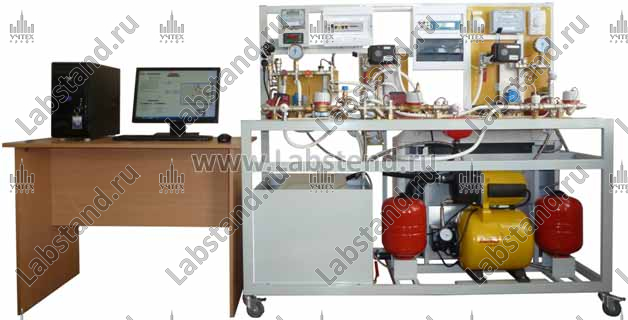
To study the structure and principle of operation of automated heating substations, experimental study of processes in heating systems, hot water supply systems, remote monitoring and control of the operation of heating substations.
The complex can be used for laboratory work on the courses «Heat Supply», «Heating and Heating Systems», «Heat Engineering Measurements» and «Automation of Heating Systems» in higher, secondary and vocational educational institutions, in the training and retraining of dispatchers.
Technical capabilities:
• Preparation of hot water at a set temperature;
• Circulation of hot water in the network of consumers in order to ensure the set temperature of hot water in the absence of its consumption;
• Control of the temperature of the supplied hot water with the issuance of the signal «DHW failure» in case the temperature exceeds the specified limits;
• Monitoring the operability of the DHW circulation pump with the possibility of switching to a backup pump, if any, or issuing a signal «Hot water pump failure»;
• Supply of a coolant to the heating system with a temperature equal to the current setpoint;
• Circulation of the coolant in the heating system;
• Control of the temperature of the coolant supplied to the heating system, with the formation of a signal «Heating failure» in case of its deviation from the specified limits;
• Monitoring the pressure in the heating system and maintaining it within the required limits;
• Monitoring the operability of the heating circulation pump with the possibility of switching to a backup pump, if any, or issuing a signal «Heating pump failure»;
• Automatic adjustment of the current heating setting point according to the outside temperature;
• Automatic change of heating mode depending on the time of day, day of the week;
• Automatic switching of the heating system to winter/summer mode;
• Diagnostics of the state of sensors, with the issuance of alarms in case of their malfunctions;
• Setting the values of programmable parameters from the controller keyboard or from a PC;
• Remote control and management of the point via the ModBus-RTU protocol;
• Measurement of the amount of electricity consumed by the thermal energy module;
• Measurement of the amount of heat energy supplied to the heating network;
• Measurement of the amount of energy used by the heating system and the hot water supply system.
• The complex is equipped with a source of thermal energy with an automatic regulator (equivalent to a heating network), a source of cold water under pressure (equivalent to a cold water supply system), a variable heat load for the heating module;
• The complex does not require connection to the heating network, a source of cold water supply and sewerage;
Composition:
• Complete floor laboratory unit, including: heat generator with automatic temperature control, make-up and pressure stabilization unit, differential pressure regulator in the heating network; hot water module with control valve, heat exchangers, circulating pump; heating module with control valve, heat exchanger, circulation pump; coolant pressure make-up and stabilization unit; variable heat load; shut-off and control valves; control controller, controls, light and sound alarms; temperature and pressure sensors that ensure the functioning of the heating station; temperature sensors, flow meters, heat meters, electricity meters that provide electricity and heat metering.
• PC with WIN OS, a specialized remote monitoring and control program;
• Instruction manual.